
Pie Guage
Assured
Returns
Enquiry
Support
The Pie Gauge: An Essential Tool in Magnetic Particle Inspection (MPI)
The Pie Gauge, also known as the Magnetic Flux Indicator or B-H Meter, is a simple yet indispensable accessory used in Magnetic Particle Inspection (MPI). It serves a crucial function: visually and instantaneously confirming the presence, strength, and direction of the magnetic field being induced in a ferromagnetic component. While it does not provide quantitative measurements, it is a rapid, practical tool for ensuring the magnetization process is effective before proceeding with the actual inspection.
Design and Construction
The Pie Gauge is designed for maximum sensitivity to magnetic fields and typically consists of the following key features:
-
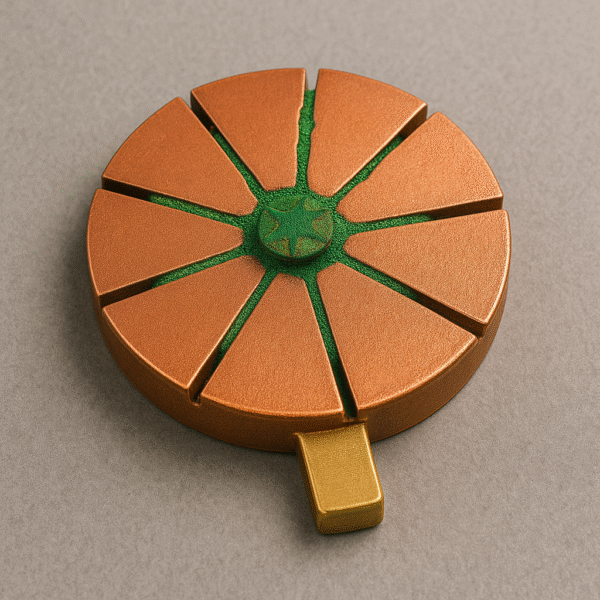
Eight Segments: The gauge is composed of eight wedge-shaped, highly permeable (easily magnetized) steel segments that are brazed or welded together. This construction is designed to create a discontinuity at the boundaries between the segments.
-
Non-Ferrous Spacing: Crucially, a thin layer of non-ferrous material separates the eight segments at their central meeting point, forming an artificial star-shaped discontinuity. This intentional gap is where the magnetic particles will be drawn to and held, indicating the presence of a magnetic field.
-
Brass Backing: The segments are mounted on a non-magnetic brass backing plate, which holds the segments together and provides a handle for the inspector.
-
Copper Plating: The entire assembly is often copper plated to protect the highly permeable steel segments from corrosion and wear, as the gauge is used directly on component surfaces.
Principle of Operation: Detecting Field Direction
The Pie Gauge operates based on the fundamental principle of flux leakage in MPI.
-
Field Induction: When the Pie Gauge is placed on the surface of a ferromagnetic component and the component is magnetized (using a yoke, coil, or bench), the magnetic flux lines pass through the highly permeable steel segments.
-
Flux Leakage: At the junction between the metal segments—the star-shaped discontinuity—the magnetic lines of flux are forced to leak out of the surface to bridge the gap.
-
Indication Formation: When dry magnetic powder or wet magnetic particle suspension is applied to the gauge, the particles are instantly drawn to these flux leakage fields.
Interpreting the Results
-
Strong Field: If the magnetic field is strong and correctly aligned, a bright, clear indication will form across a minimum of three adjacent segments.
-
Weak Field: A weak field will result in a faint or poorly defined indication.
-
Multidirectional Field: If the indication forms across gaps in two different directions (e.g., forming a clear 'plus' sign), it suggests a complex or multidirectional magnetic field, which is often desirable for comprehensive inspection but requires careful interpretation.
No Reviews Yet
Be the first to share your experience with this product.
Get a Quote for Pie Guage
Our NDT specialists will respond within 24 hours with pricing, specifications, and lead times. For urgent requirements, reach us directly via WhatsApp or phone.