
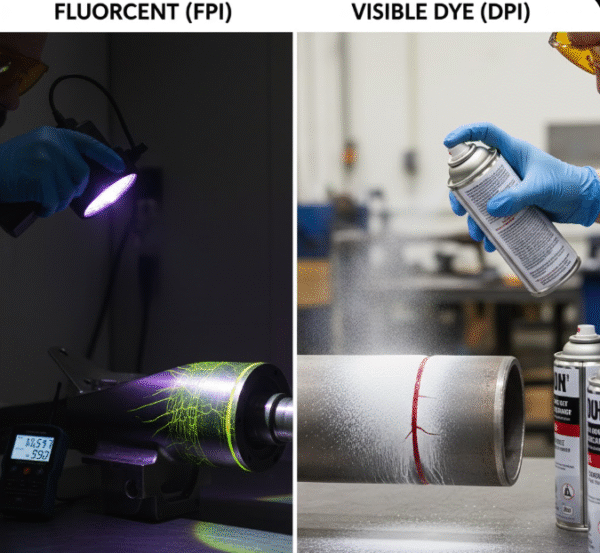
Fluorescent (FPI) & Visible Dye Systems
Assured
Returns
Enquiry
Support
Fluorescent (FPI) & Visible Dye Systems: Liquid Penetrant Inspection (LPI/PT)
Fluorescent Penetrant Inspection (FPI) and Visible Dye Penetrant Inspection (DPI) are the two primary techniques within Liquid Penetrant Inspection (LPI), a widely used non-destructive testing (NDT) method for detecting surface-breaking flaws in non-porous materials.
Both systems rely on the same five fundamental steps, but they differ critically in the chemicals used and the required viewing conditions.
FPI: High Sensitivity Method
Fluorescent Penetrant Inspection (FPI) is the highest sensitivity method, used for detecting extremely fine or shallow defects, particularly in critical components (e.g., aerospace, nuclear).
Key Features:
-
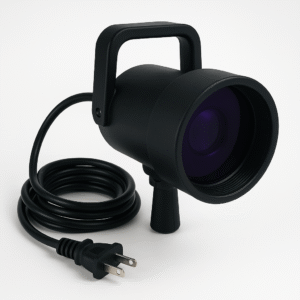
Penetrant: The penetrant contains a fluorescent dye that glows intensely when exposed to Ultraviolet (UV-A) light (black light).
-
Developer: The developer is typically a white, thin coating that provides a contrasting background and draws the penetrant out of the flaw.
-
Viewing: Inspection must take place in a darkened area (inspection booth) using a calibrated UV-A lamp (black light).
-
Indication: Flaws appear as a bright, glowing yellow-green line or spot against the dark, non-fluorescing background.
-
Process: FPI systems are categorized by the method used to remove excess penetrant: water-washable, post-emulsifiable lipophilic (oil-based), or post-emulsifiable hydrophilic (water-based).4
Visible Dye Systems (DPI): General Purpose Method
Visible Dye Penetrant Inspection (DPI), also called Color Contrast Penetrant, is the more common, general-purpose method, valued for its simplicity, speed, and portability.
Key Features:
-
Penetrant: The penetrant contains a highly saturated, deep red dye.
-
Developer: The developer is a white, absorbent powder or liquid coating applied to the surface.
-
Viewing: Inspection is performed under normal white light (daylight or artificial light).
-
Indication: Flaws appear as clear, sharp red lines or spots bleeding out onto the white developer background.
-
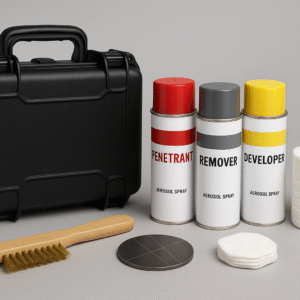
Portability: DPI systems are often available in aerosol cans (solvent-removable or water-washable systems), making them highly portable for field use and on-site testing.
Comparison Summary
| Feature | Fluorescent Penetrant (FPI) | Visible Dye Penetrant (DPI) |
| Sensitivity | Very High | Medium |
| Penetrant Color | Yellow-Green | Red |
| Viewing Light | UV-A Black Light (Darkened Area) | White Light (Normal Ambient) |
| Ideal For | Fine, shallow flaws; critical components | Larger flaws; general purpose field testing |
| Safety Gear | UV Protective Goggles are mandatory | No special eye protection needed |
The choice between FPI and DPI is determined by the required sensitivity, the viewing environment, and the surface condition of the component.
No Reviews Yet
Be the first to share your experience with this product.
Get a Quote for Fluorescent (FPI) & Visible Dye Systems
Our NDT specialists will respond within 24 hours with pricing, specifications, and lead times. For urgent requirements, reach us directly via WhatsApp or phone.