
Distance Amplitude Correction (DAC) Blocks
Assured
Returns
Enquiry
Support
Purpose of DAC Blocks
The primary function of a DAC block is to compensate for two main effects in ultrasonic testing:
-
Beam Spreading (or Diffraction): As the ultrasonic beam travels through a material, it naturally spreads out, which reduces the sound energy density and, consequently, the signal amplitude.
-
Attenuation: Sound energy is lost due to absorption (conversion to heat) and scattering (reflection in directions other than back to the transducer) as it travels through the material.
Without correction, a small flaw close to the surface might produce a larger echo than an identical small flaw deeper within the material. The DAC curve generated using the block allows the technician to adjust the gain of the UT instrument so that flaws of the same size produce the same amplitude signal, regardless of their depth.
Structure and Use
Structure
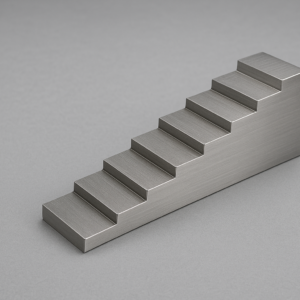
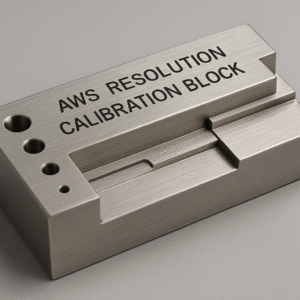
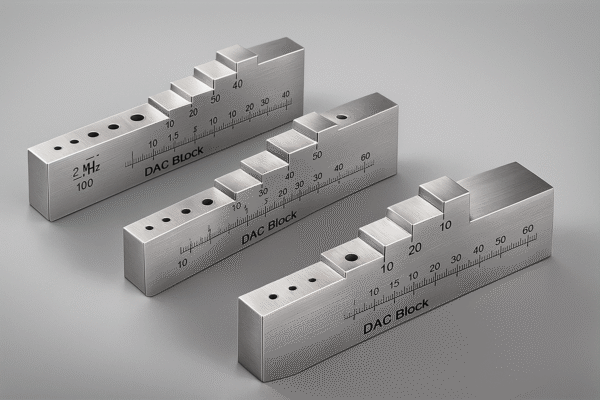
A standard DAC block is typically made of the same material (or acoustically equivalent material) as the component being inspected (e.g., steel, aluminum). It contains a series of side-drilled holes (SDH) or flat-bottom holes (FBH) of the same diameter drilled at varying depths (distances) from the scanning surface.
Procedure
-
Calibration: The UT transducer is scanned over the block, and the peak amplitude from each reference reflector (hole) is recorded at its respective depth.
-
DAC Curve Generation: A line or curve is electronically drawn (or manually plotted) connecting the peak amplitudes from each reflector.6 This is the primary DAC curve.
-
Reference Lines: Code-required reference lines other specific thresholds) are added relative to the primary DAC curve to establish acceptance/rejection criteria for flaws found in the actual component.
-
Inspection: During the actual inspection, the instrument's gain is automatically or manually adjusted so that the primary DAC curve is represented as a constant reference level across the entire depth range on the A-scan display.
Standards
DAC block design and use are governed by various industry codes and standards, such as those from the American Society of Mechanical Engineers (ASME), American Petroleum Institute (API), and the American Society for Nondestructive Testing (ASNT). These standards specify the material, hole sizes, and distances required for the specific application (e.g., weld inspection, forging inspection).
No Reviews Yet
Be the first to share your experience with this product.
Get a Quote for Distance Amplitude Correction (DAC) Blocks
Our NDT specialists will respond within 24 hours with pricing, specifications, and lead times. For urgent requirements, reach us directly via WhatsApp or phone.