
PAUT Calibration Block
Assured
Returns
Enquiry
Support
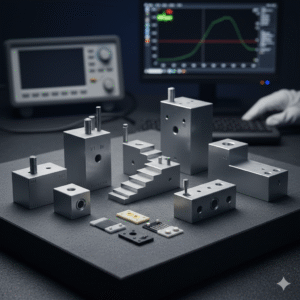
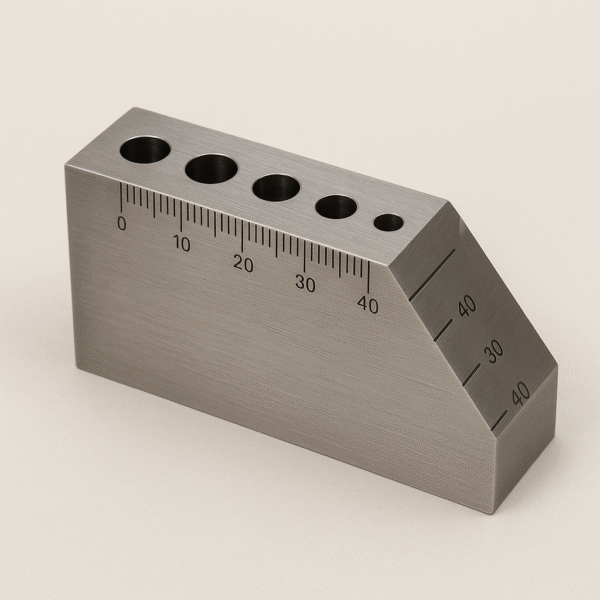
A PAUT Calibration Block is a specialized reference standard used to set up, calibrate, and verify the performance of a Phased Array Ultrasonic Testing (PAUT) system.
Because PAUT systems can electronically steer and focus the ultrasonic beam across a range of angles, the calibration blocks must incorporate features that allow for the validation of these advanced capabilities.
Calibration Functions of a PAUT Block
Unlike conventional single-element UT blocks, PAUT blocks are designed to perform several critical calibrations simultaneously across a defined scan area:
-
Wedge Delay and Velocity Calibration: Used to accurately determine the sound velocity in the material and the time delay introduced by the wedge (shoe) that separates the transducer from the test surface.
-
Time-Corrected Gain (TCG) / DAC: Allows the system to compensate for signal loss due to beam spread and material attenuation across various depths and angles, ensuring flaws of the same size generate the same amplitude signal regardless of location.
-
Angle Verification and Beam Steering: Provides targets (reflectors) at specific angular and linear positions to confirm that the electronic beam steering and focusing are accurate for the programmed focal laws.
-
Resolution and Sensitivity: Used to check the system's ability to distinguish between closely spaced reflectors and to establish the minimum detectable flaw size.
Key Types and Features
PAUT blocks are available in various configurations, often based on specific industry codes or the geometry of the component being inspected.
1. General Assessment Blocks (Type A/B or ASTM E2491)
These blocks are multi-purpose standards used to assess overall system performance.
-
Features: Often contain multiple Side-Drilled Holes (SDHs) and Flat-Bottom Holes (FBHs) placed at varying depths and radial distances, sometimes within curved sections.
-
Purpose: Excellent for establishing TCG curves, checking angular resolution, and demonstrating beam steering capability across a wide range of angles.
2. ASME and AWS PAUT Blocks
These blocks are modifications of traditional code-required blocks, adapted for phased array:
-
ASME Pipe Block (Modified): A section of pipe with the same nominal size, thickness, and material as the component being inspected. It includes reference SDHs and notches for TCG, angle verification, and sensitivity calibration on a curved surface.
-
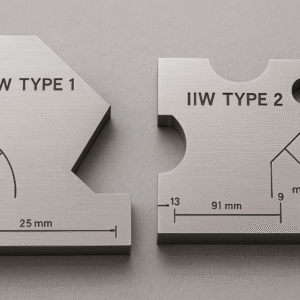
PAUT IIW Block (ISO 19675): A modern version of the conventional IIW block, it includes features (like corner trap reflectors and additional holes) specifically for checking phased array functions such as grating lobe assessment and active element integrity.
3. Weld Validation Blocks
These blocks are designed to mimic the actual inspection component and often serve as qualification or demonstration blocks:
-
Features: They contain an actual weld joint (e.g., a V-groove or double-V groove) in the same material, complete with intentionally introduced simulated flaws such as EDM notches (to simulate lack of fusion) and other features to represent service-induced or fabrication flaws.
-
Purpose: These are used to validate the entire PAUT inspection procedure, including the scan plan and sizing techniques, under realistic conditions as required by codes like ASME Section V or API 1104.
Standards
PAUT blocks must be manufactured to high precision and are governed by specific Non-Destructive Testing (NDT) standards:
-
ASTM E2491: Standard Guide for Evaluating Performance Characteristics of Phased-Array Ultrasonic Testing Instruments and Systems.
-
ISO 19675: Specifies requirements for a calibration block for phased array testing (PAUT), serving as an international standard for a multi-purpose PAUT block.
-
ASME Section V, Article 4: Provides guidelines on the required calibration reflectors and procedures, emphasizing that the calibration block should acoustically match the component being inspected.
No Reviews Yet
Be the first to share your experience with this product.
Get a Quote for PAUT Calibration Block
Our NDT specialists will respond within 24 hours with pricing, specifications, and lead times. For urgent requirements, reach us directly via WhatsApp or phone.