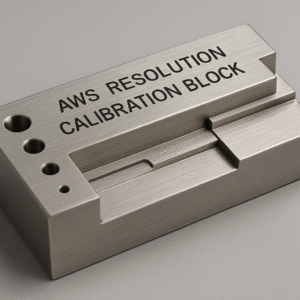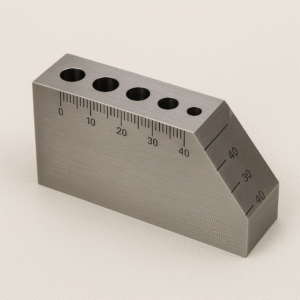

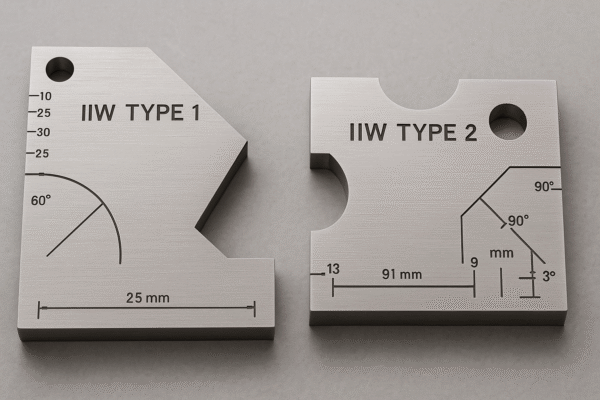
IIW Type 1 & IIW Type 2 Blocks
Assured
Returns
Enquiry
Support
IIW Type 1 & IIW Type 2 Blocks: Calibration Standards in Ultrasonic Testing (UT)
The International Institute of Welding (IIW) Calibration Blocks are the most widely used and globally recognized reference standards for calibrating, checking linearity, and verifying the performance of Ultrasonic Testing (UT) equipment.1 These blocks contain precisely machined features that allow inspectors to set up their instruments accurately.
1. IIW Type 1 Block (V1 Block)
The IIW Type 1 Block is the primary, general-purpose standard used for initial calibration.
Key Functions:
-
Zero Calibration: Used to set the instrument's delay time or index point to zero, compensating for the delay inherent in the transducer and cable assembly.
-
Time Base Calibration (Range): Used to set the UT instrument's display screen (time base) to accurately represent the depth of the material in units of distance .
-
Material Velocity Check: The block allows for verification of the material's sound velocity by accurately measuring the time it takes for sound to travel a known distance.
-
Beam Index Point (BIP): Used to locate the exact point where the sound beam exits the angle beam transducer.
-
Angle Verification: Used to verify the actual refracted angle of the beam from an angle beam transducer. The block includes large and small radii for this purpose.
Design Features:
The Type 1 block is typically made from steel or aluminum and features:
-
A major thickness of 6$25\ \text{mm}$ (7$1.0\ \text{in}$).
-
A large $100\ \text{mm}$ ($\approx 4\ \text{in}$) radius section and a smaller radius section.
-
A $50\ \text{mm}$ hole for zeroing straight beam probes.
-
A 9$1.5\ \text{mm}$ diameter side-drilled hole (SDH).
2. IIW Type 2 Block (V2 Block)
The IIW Type 2 Block is a more compact version designed for on-site, daily, or shift-start checks after the initial calibration has been set using the Type 1 block.
Key Functions:
-
Quick Calibration Check: Used for rapid verification of the instrument's calibration and linearity before and during an inspection shift.
-
Beam Index Point (BIP) Check: Used to quickly confirm the exit point of the angle beam probe.
-
Angle Verification: Used to check the probe's refracted angle using the $25\ \text{mm}$ radius section.
-
Sensitivity Check: The $50\ \text{mm}$ path (or the $3\ \text{mm}$ diameter side-drilled hole) is used to verify the inspection sensitivity.
Design Features:
The Type 2 block is also typically made from steel or aluminum and is smaller and lighter than the Type 1:
-
Features a $25\ \text{mm}$ radius (used for angle beam probe checks).
-
Contains a $3.0\ \text{mm}$ diameter side-drilled hole (SDH).
-
Has a $5\ \text{mm}$ diameter through-hole.
In practice, the IIW Type 1 block is used for the initial setup and major calibration of the UT equipment, while the IIW Type 2 block is used for periodic, on-the-job verification of that setup.
No Reviews Yet
Be the first to share your experience with this product.
Get a Quote for IIW Type 1 & IIW Type 2 Blocks
Our NDT specialists will respond within 24 hours with pricing, specifications, and lead times. For urgent requirements, reach us directly via WhatsApp or phone.