
Feeler Gauges & Thread Gauges
Assured
Returns
Enquiry
Support
Feeler Gauges & Thread Gauges: Essential Gaging Tools
Feeler Gauges and Thread Gauges are simple, yet crucial, inspection tools known as limit gauges. They are used to verify that specific gaps, clearances, or screw thread dimensions fall within acceptable tolerances without requiring complex measurement setups.
1. Feeler Gauges (Gap Gauges)
Feeler gauges are used to measure the distance between two parts or the clearance in a small gap where high precision is required.
-
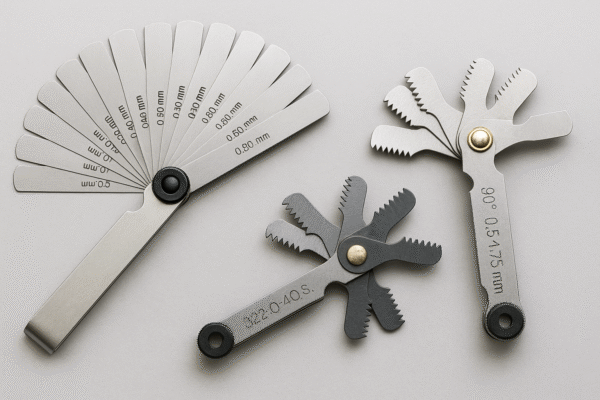
Design: A feeler gauge is a set of small blades (leaves) of carefully controlled thickness, usually bound together in a protective holder. Each blade is marked with its specific thickness.
-
Applications:
-
Setting spark plug gaps in engines.
-
Measuring valve clearances or lash.
-
Checking bearing clearances and flat surface parallelism.
-
2. Thread Gauges (Screw Pitch Gauges)
Thread gauges, specifically Screw Pitch Gauges, are used to identify and verify the pitch (distance between threads) of a screw thread.
-
Design: A thread gauge consists of a set of leaves, each meticulously cut with teeth corresponding to a specific thread pitch (or thread per inch, TPI).
-
Principle: The operator matches the profile of the gauge leaf to the profile of the screw thread. When the correct leaf is found, it will nest perfectly into the threads without rocking or leaving any gap between the gauge teeth and the thread flanks.
-
Applications:
-
Identifying unknown screw threads (metric pitch like $1.5\ \text{mm}$ or imperial TPI like $12\ \text{TPI}$).
-
Checking the pitch accuracy of internal or external threads to ensure they meet specifications before assembly.
-
Identifying damaged or deformed threads.
-
Both tools are considered essential for maintaining quality control and ensuring proper assembly and function across many mechanical and engineering disciplines.
No Reviews Yet
Be the first to share your experience with this product.
Get a Quote for Feeler Gauges & Thread Gauges
Our NDT specialists will respond within 24 hours with pricing, specifications, and lead times. For urgent requirements, reach us directly via WhatsApp or phone.