
ISO Certified
ISO Certified
Global Shipping
Expert Support
Vertex Systems
Dial Indicators / Dial Test Indicators
Price on Request
Contact us for a quote
Quality
Assured
Assured
Easy
Returns
Returns
Secure
Enquiry
Enquiry
Expert
Support
Support
Dial Indicators / Dial Test Indicators
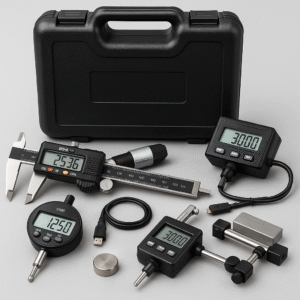
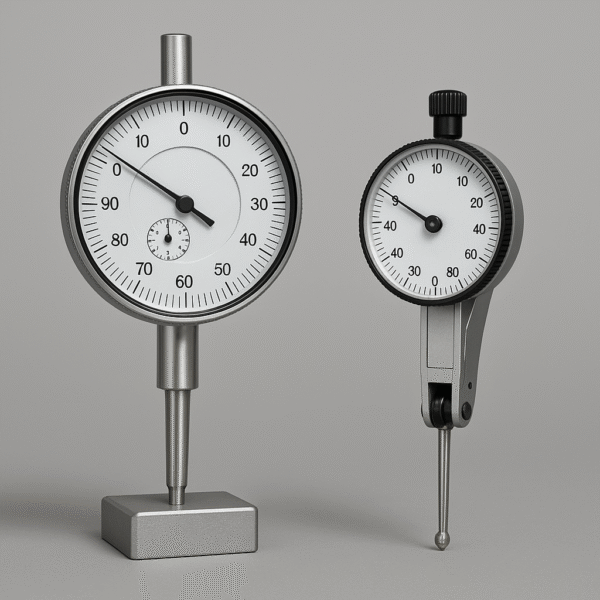
Dial indicators and dial test indicators are precision measurement tools widely used in machining, metalworking, calibration, and quality control applications. These instruments provide highly accurate readings of small linear or angular displacements, making them essential for ensuring alignment, verifying tolerances, and maintaining dimensional accuracy in industrial environments. While both tools perform similar functions, each is designed for specific types of measurement, offering unique strengths.Dial Indicators
Dial indicators—also known as plunger indicators—measure small linear distances using a spring-loaded plunger that moves in and out. This movement is translated into the rotation of a pointer on a graduated dial. Standard dial indicators typically measure ranges from 0–10 mm or 0–1 inch, with resolutions as fine as 0.01 mm or 0.001 inch. These indicators are commonly used for:- Checking flatness, straightness, and parallelism
- Measuring runout on rotating components
- Aligning machine tool setups
- Verifying the accuracy of fixtures and jigs
- Precision centering on milling machines and lathes
Dial Test Indicators
Dial test indicators—often called “DTIs” or lever-type indicators—are designed to measure small angular deflections rather than linear motion. Instead of a plunger, they use a pivoting stylus or lever arm that transfers movement to the dial. This makes them ideal for measuring surfaces where minimal force or deflection is required. Dial test indicators excel in tasks such as:- Inspecting surface flatness and profile
- Measuring alignment between two surfaces
- Detecting subtle variations in height or contour
- Checking runout in tight or confined areas
- Setting up precision milling or grinding machines
Importance in Precision Measurement
Both dial indicators and dial test indicators play a crucial role in ensuring accuracy during machining, assembly, and inspection. They help operators maintain tight tolerances, reduce error, and improve overall part quality. With proper calibration and care, these instruments provide long-lasting performance and dependable precision. Whether performing routine machine setups, high-precision inspections, or geometric checks, dial and dial test indicators remain indispensable tools in any engineering or manufacturing environment—ensuring consistency, accuracy, and confidence in every measurement.No Reviews Yet
Be the first to share your experience with this product.
Get a Quote for Dial Indicators / Dial Test Indicators
Our NDT specialists will respond within 24 hours with pricing, specifications, and lead times. For urgent requirements, reach us directly via WhatsApp or phone.