
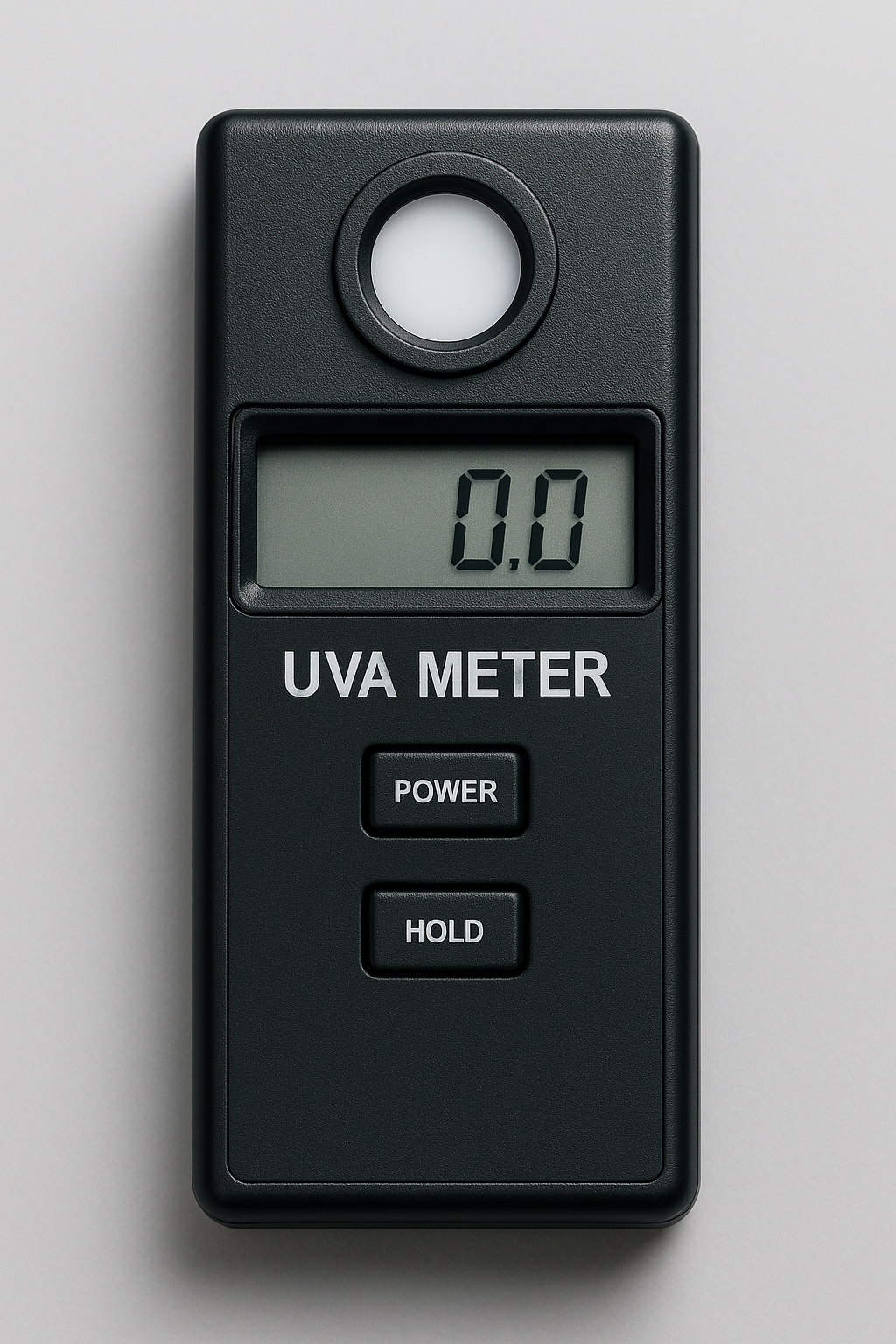
UVA meter
Description
UVA Meter (Radiometer): Measuring Black Light Intensity in NDT
A UVA Meter, also known as an Ultraviolet Radiometer or Black Light Meter, is a critical instrument used in Non-Destructive Testing (NDT) to quantitatively measure the intensity of the UV-A light (black light) emitted by inspection lamps. This measurement ensures that the light source is powerful enough to excite the fluorescent materials used in MPI and PT.
Function and Design
-
Measurement Focus: The meter is specifically designed to measure the intensity of light in the UV-A spectrum (typically $320\ \text{nm}$ to $400\ \text{nm}$), with peak sensitivity often tuned to $365\ \text{nm}$, the standard wavelength used for fluorescent inspection.
-
Units: The intensity is measured in microwatts per square centimeter ($\mu W/cm^2$).
-
Components: A typical UVA meter consists of:
-
Sensor/Detector: A specialized filter and photodiode that isolates and measures only the UV-A energy.
-
Display Unit: A digital readout that displays the measured intensity.
-
-
Calibration: These meters must be regularly calibrated against traceable standards to ensure accuracy, as mandated by NDT codes.
Importance in NDT Compliance
Using a UVA meter is a mandatory requirement for maintaining the sensitivity and reliability of fluorescent NDT methods:
-
Sensitivity Verification: Standards (such as ASTM E1444 and ISO 3059) require a minimum UV-A intensity at the inspection surface, often $1000\ \mu W/cm^2$ (or $10\ \text{W/m}^2$). The meter confirms the lamp meets this threshold.
-
White Light Measurement: Many radiometers also have a secondary sensor to measure ambient visible light (white light), measured in lux or foot-candles. This ensures the inspection area is dark enough (typically less than $20\ \text{lux}$) to achieve high contrast for fluorescent indications.
-
Traceability: The readings provide a quantitative record for audit purposes, proving that the inspection was performed under the specified lighting conditions.

Reviews
There are no reviews yet.