
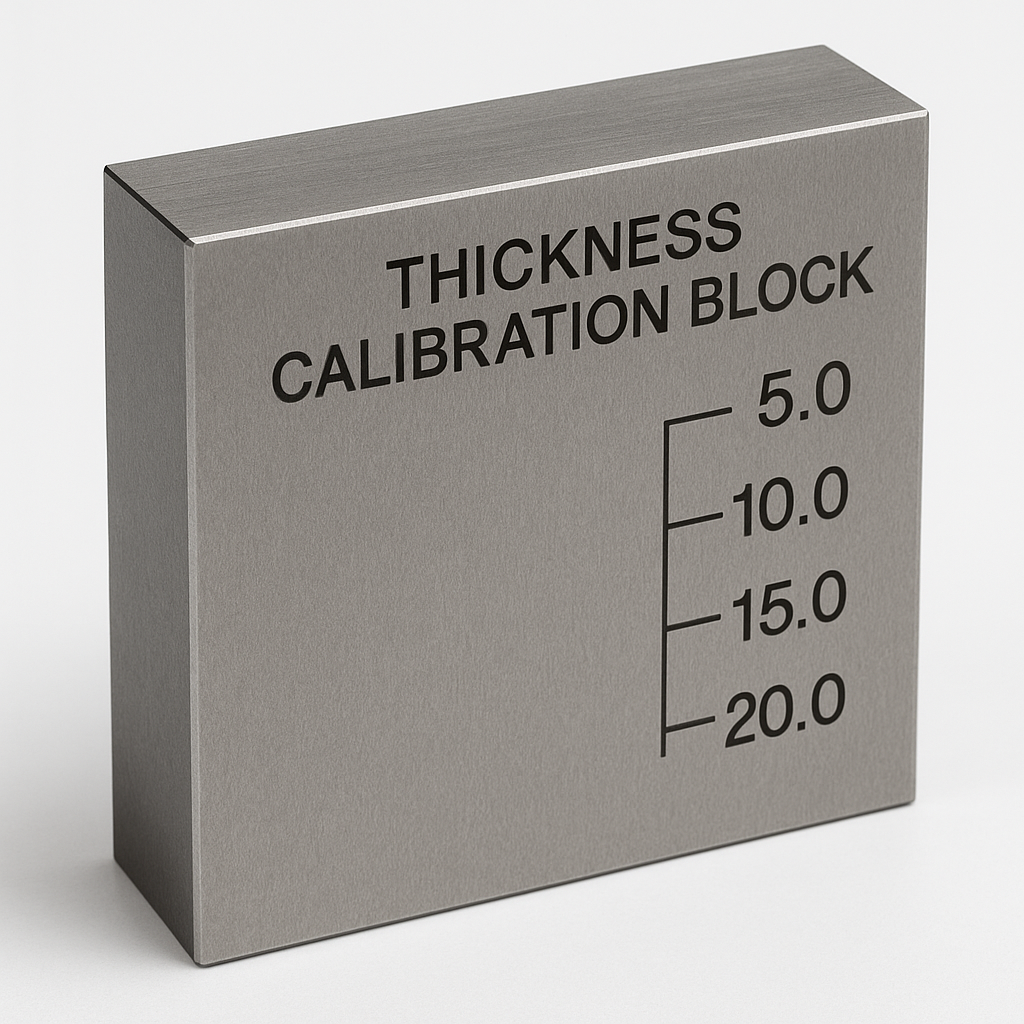
Thickness Calibration Block
Description
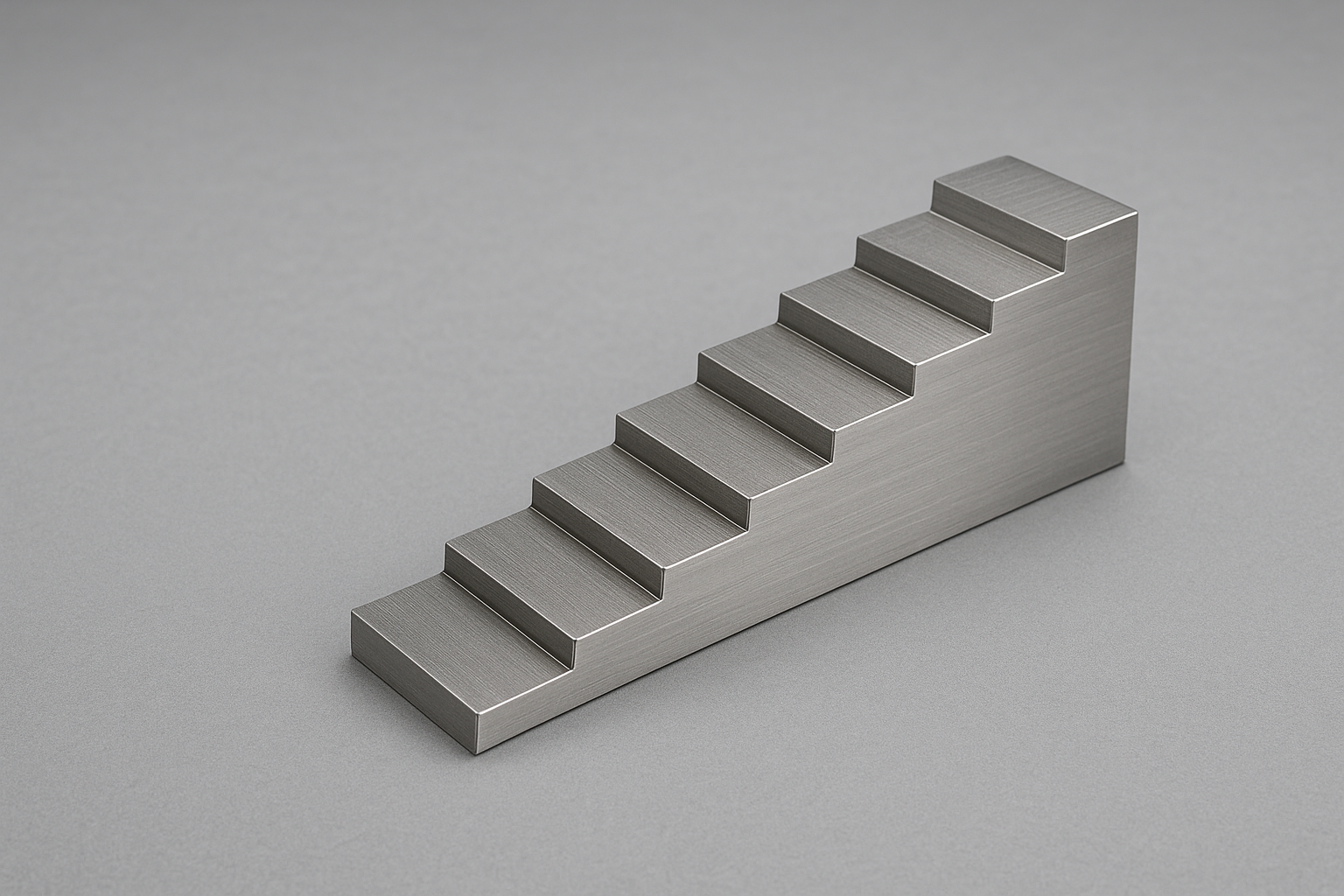
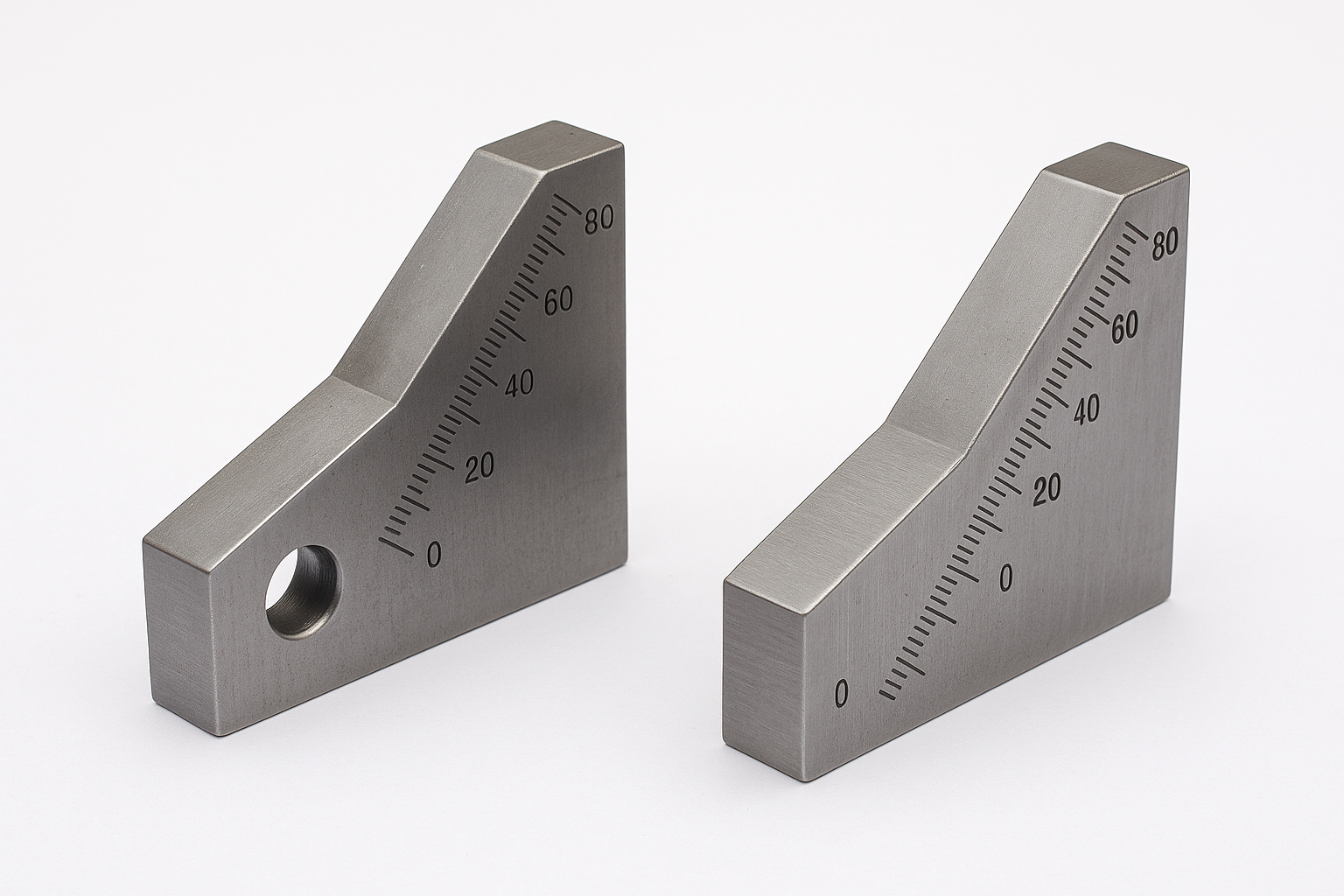
A Thickness Calibration Block, often referred to as a Step Block or Step Wedge, is a reference standard used in Ultrasonic Testing (UT) specifically to calibrate and verify the accuracy of ultrasonic thickness gauges and flaw detectors for measuring material thickness.
Purpose and Function
The primary purpose of a thickness calibration block is to provide known, traceable thickness values to:
-
Set Sound Velocity: The block is used to set the correct acoustic sound velocity in the UT instrument. The instrument measures the time it takes for the sound pulse to travel through the material and return. By measuring a step of known thickness ($T$), the instrument calculates the velocity ($V$) using the formula: $V = 2T / t$ (where $t$ is the time of flight).
-
Verify Linearity: It allows the operator to verify that the instrument’s thickness readings are accurate across a range of thicknesses, ensuring the gauge is linear.
-
Establish Near-Surface Resolution: For very thin steps, it helps determine the minimum thickness the transducer and instrument combination can accurately measure.
-
Confirm Zero Offset: It helps ensure that any delay in the transducer or cable (known as the “zero offset”) is properly compensated for.
Structure and Types
Thickness calibration blocks are typically designed as a series of steps with precise, machined thickness values.
Common Step Block Types
-
4-Step, 5-Step, or 10-Step Blocks: These are the most common configurations. They are rectangular or square blocks with a staircase-like profile, each step having a highly accurate, certified thickness.
-
Material: To ensure accurate results, the block must be made of the same material (or one with an acoustically identical velocity) as the component being inspected (e.g., 1018 Steel, 7075-T6 Aluminum).
-
Dimensions: Step thicknesses are typically provided in either metric units (e.g., 2.5 mm, 5.0 mm, 7.5 mm, 10.0 mm, 12.5 mm) or imperial units (e.g., $0.100^{\prime\prime}, 0.200^{\prime\prime}, 0.300^{\prime\prime}, 0.400^{\prime\prime}, 0.500^{\prime\prime}$).
-
Related Standard Blocks
While not strictly “thickness blocks,” other standards blocks are used for general ultrasonic equipment setup, including:
-
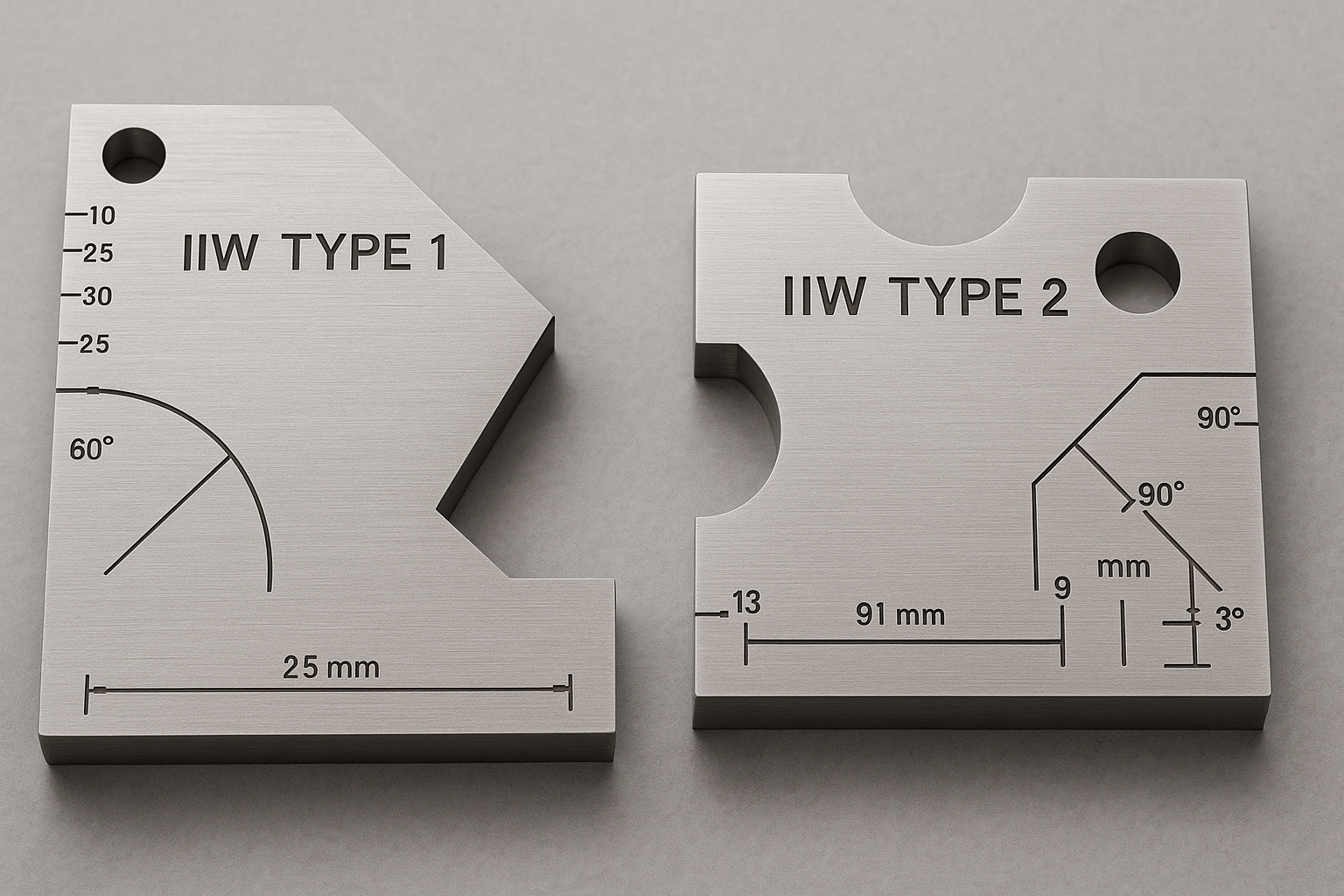
IIW Blocks (International Institute of Welding): Used primarily for setting refracted angle, beam index point, and distance/sensitivity for both straight and angle beam probes.
-
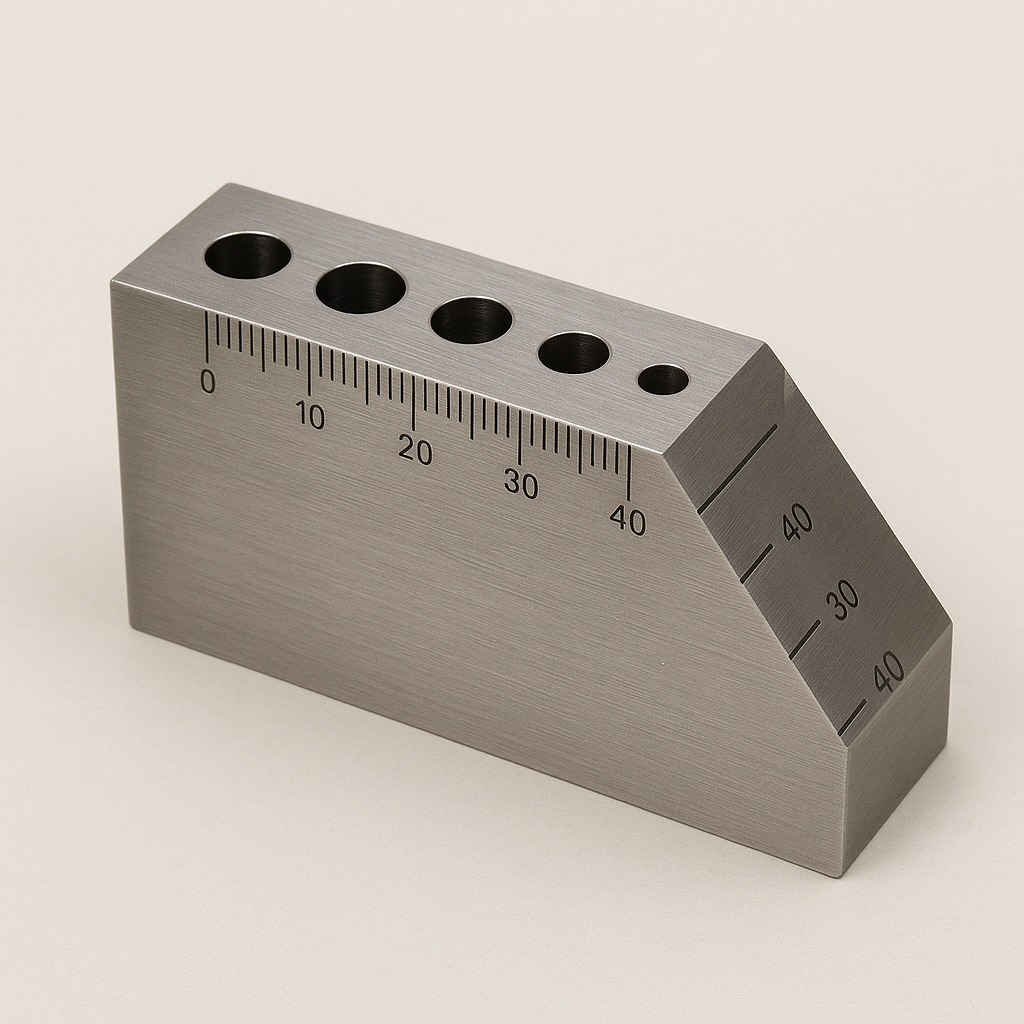
DAC Blocks (Distance Amplitude Correction): Used to compensate for beam spread and attenuation, ensuring flaw echoes of the same size appear equal regardless of their depth.

Reviews
There are no reviews yet.