
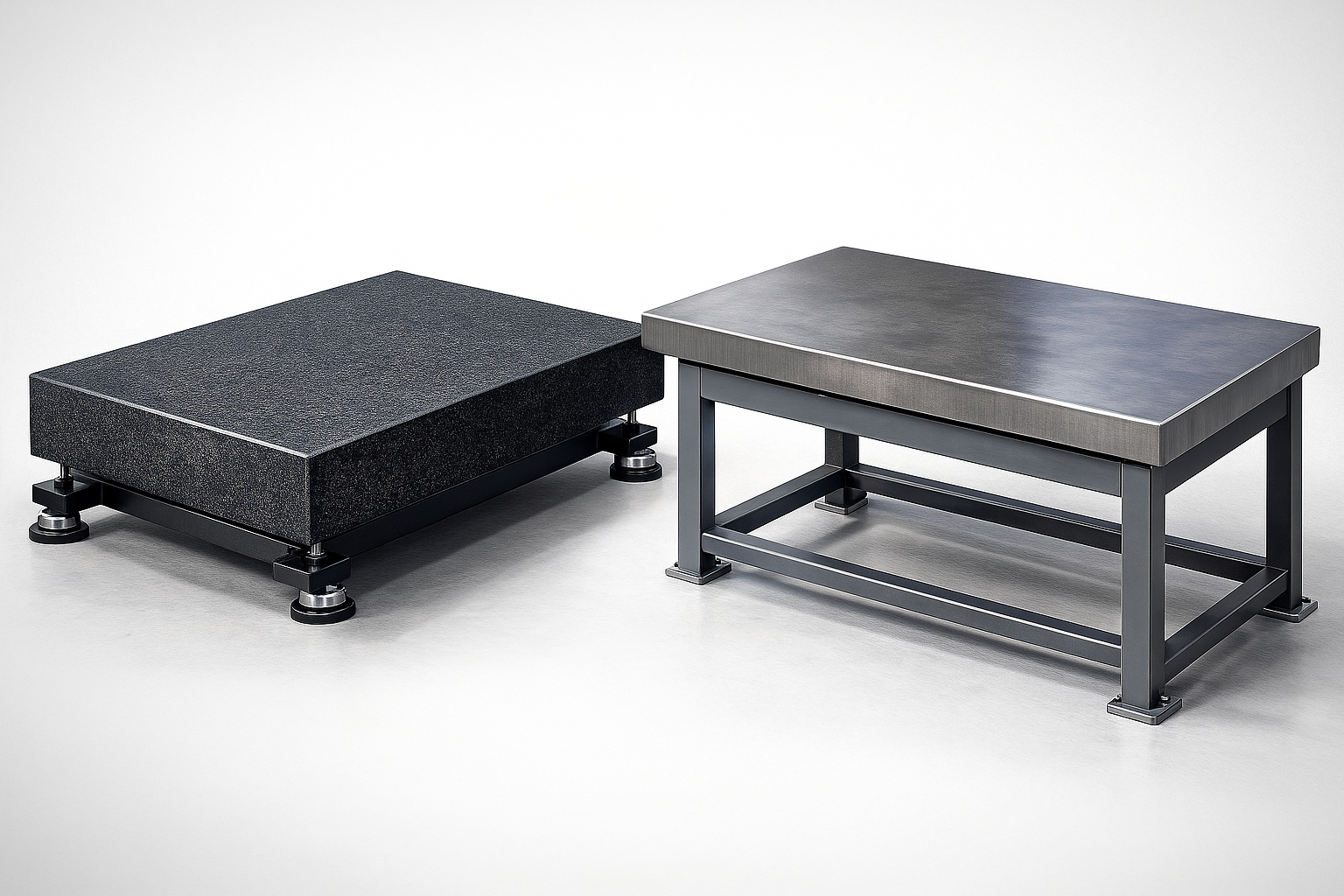
Surface Plates (Granite / Cast Iron)
Description
Surface Plates: The Foundation of Precision Measurement
Surface Plates are fundamental tools in dimensional metrology and quality control, serving as highly accurate, rigid, and flat reference planes. They provide a precise horizontal datum (a defined starting point) against which measurements are taken, ensuring that all subsequent measurements of height, flatness, or alignment are accurate.
They are typically manufactured from either granite or high-grade cast iron, with the choice depending on the application, required precision, and budget.
1. Granite Surface Plates (The Modern Standard)
Granite plates are the most common type used today, prized for their exceptional stability and unique material properties.
Key Features:
-
Dimensional Stability: Granite is naturally inert and non-magnetic. It does not rust, creep, or swell due to changes in humidity, providing long-term dimensional stability.
-
Thermal Stability: It has a low coefficient of thermal expansion, meaning its size changes very little with temperature fluctuations, which is critical for precision.
-
Wear Resistance: If a part or measuring tool is accidentally dropped onto a granite plate, the material is more likely to flake away a few microscopic crystals rather than raise a burr (a common issue with metal plates). This burr-free characteristic ensures the reference plane remains flat.
-
Damping: Granite has superior vibration damping qualities, which helps settle high-precision measurements quickly.
-
Maintenance: Easy to clean and maintain, as it doesn’t require oiling to prevent rust.
2. Cast Iron Surface Plates (The Traditional Choice)
Cast iron plates were historically the standard and are still used today, particularly in tooling and manufacturing environments.
Key Features:
-
T-Slots and Inserts: The main advantage is that cast iron can be machined to incorporate T-slots or threaded inserts. This allows components or fixtures to be securely clamped directly onto the plate during layout or inspection.
-
Durability for Tooling: They are often preferred in layout rooms where heavy tools or gauges will be used, as they are less susceptible to chipping from impact than granite.
-
Repairability: Unlike granite, which must be resurfaced by specialized lapping, minor damage or wear on cast iron can sometimes be temporarily rectified by scraping.
-
Magnetic Applications: Can be useful if the application requires using magnetic clamping tools (though this compromises the plate’s absolute flatness).
3. Accuracy and Grades
Surface plates are graded based on their guaranteed flatness tolerance, often following standards like ASME B89.3.7:
| Grade | Common Name | Typical Application | Tolerance (Example) |
| Grade AA | Laboratory Master | Critical calibration and research | Tightest tolerance |
| Grade A | Inspection Grade | Precision inspection and quality control | Very tight tolerance |
| Grade B | Tool Room Grade | General inspection, layout, and shop floor use | Looser tolerance |


Reviews
There are no reviews yet.