
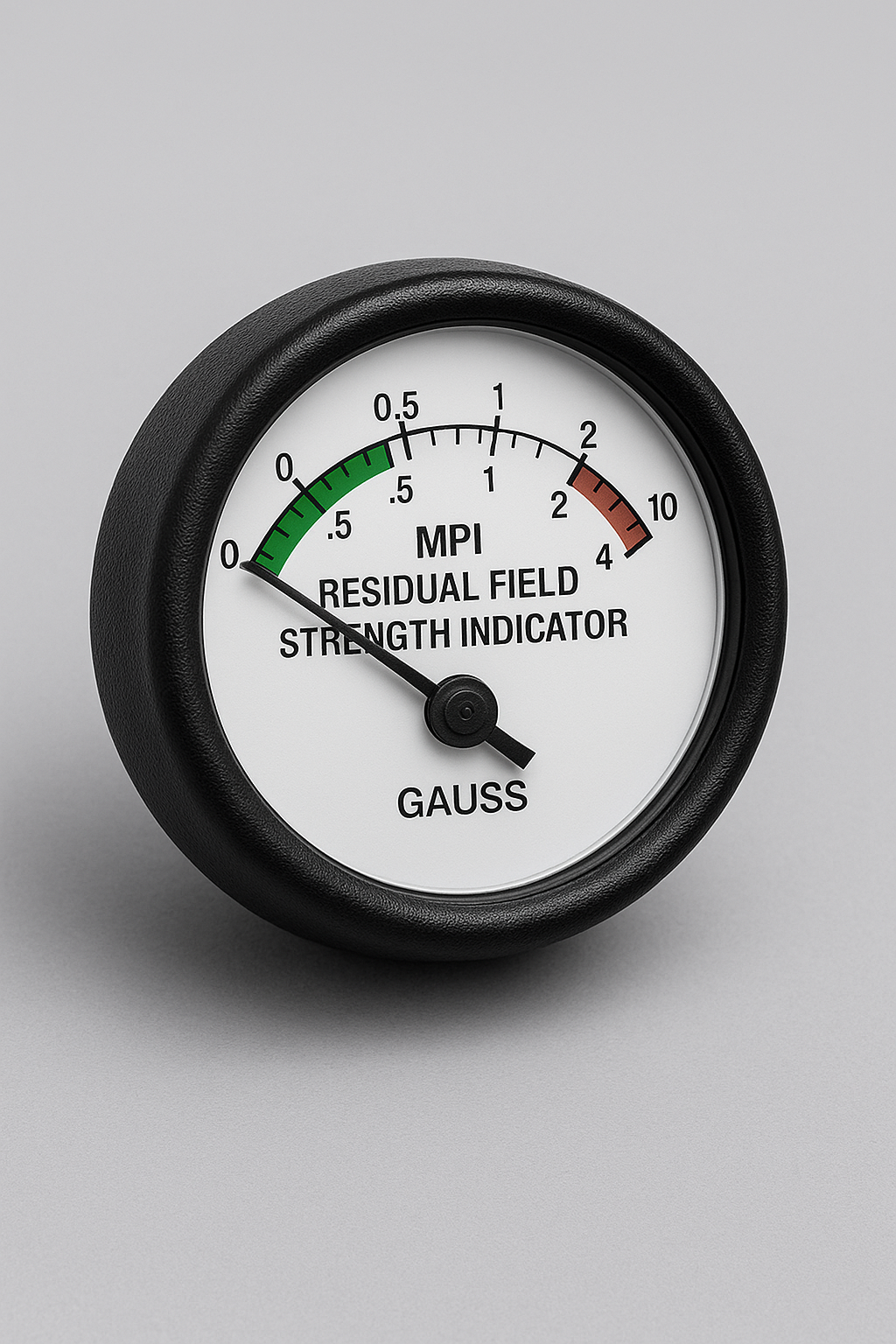
MPI residual Field Strength indicator
Description
MPI Residual Field Strength Indicator: Measuring Remanent Magnetism
The MPI Residual Field Strength Indicator, often simply called a Residual Field Indicator or Gauss Meter (when it’s a quantitative device), is a specialized instrument used in Magnetic Particle Inspection (MPI) to measure the amount of remanent magnetism (also known as residual magnetism) left in a ferromagnetic component after the magnetizing force has been removed.
Purpose
The primary purpose of measuring residual magnetism is for demagnetization verification. While MPI relies on inducing a magnetic field, it’s often critical to remove this magnetism from the part after inspection for several reasons:
-
Machining interference: Residual magnetism can cause cutting tools to become magnetized, leading to chips sticking to them, poor surface finish, and accelerated tool wear.
-
Arc blow during welding: It can interfere with subsequent welding operations, causing “arc blow” which makes welding difficult and can lead to weld defects.
-
Magnetic interference: Residual magnetism can affect sensitive electronic components or instrumentation that may interact with the inspected part.
-
Particle adhesion: In some cases, residual magnetism can cause fine metal particles or dust to adhere to the part, leading to contamination.
Design and Operation
Residual field strength indicators come in two main types:
-
Qualitative Field Indicator (Pocket Gauss Meter):
-
Design: These are typically small, simple, handheld devices, often resembling a small compass. They contain a tiny magnetized vane or needle that pivots.
-
Operation: When placed on the surface of a magnetized component, the needle deflects if a magnetic field is present.
-
Function: It provides a qualitative indication of whether residual magnetism is present and roughly how strong it is (by the degree of deflection). It does not provide an exact numerical reading. It’s often used as a quick “go/no-go” check.
-
-
Quantitative Gauss Meter / Tesla Meter:
-
Design: A more sophisticated electronic device with a digital display and a Hall Effect probe (or similar transducer).
-
Operation: The probe is placed on the component’s surface, and the device directly measures the magnetic flux density, displaying it in units of Gauss or Tesla.
-
Function: This provides an accurate, quantitative measurement of the residual magnetic field strength. This is crucial for verifying that the demagnetization process has successfully reduced the remanent magnetism below specified acceptance limits (e.g., typically less than 3 Gauss for many aerospace applications).
-
Usage in MPI
After the MPI inspection is complete and any defects have been evaluated, the demagnetization process is performed. The residual field strength indicator is then used to:
-
Confirm Demagnetization: Ensure that the component has been demagnetized to an acceptable level as defined by the applicable standard or customer specification.
-
Verify Process Effectiveness: Periodically check the effectiveness of the demagnetization equipment and procedure.
Using these indicators is a mandatory step in many MPI procedures to ensure the inspected part is fit for its subsequent service or manufacturing steps.



Reviews
There are no reviews yet.