
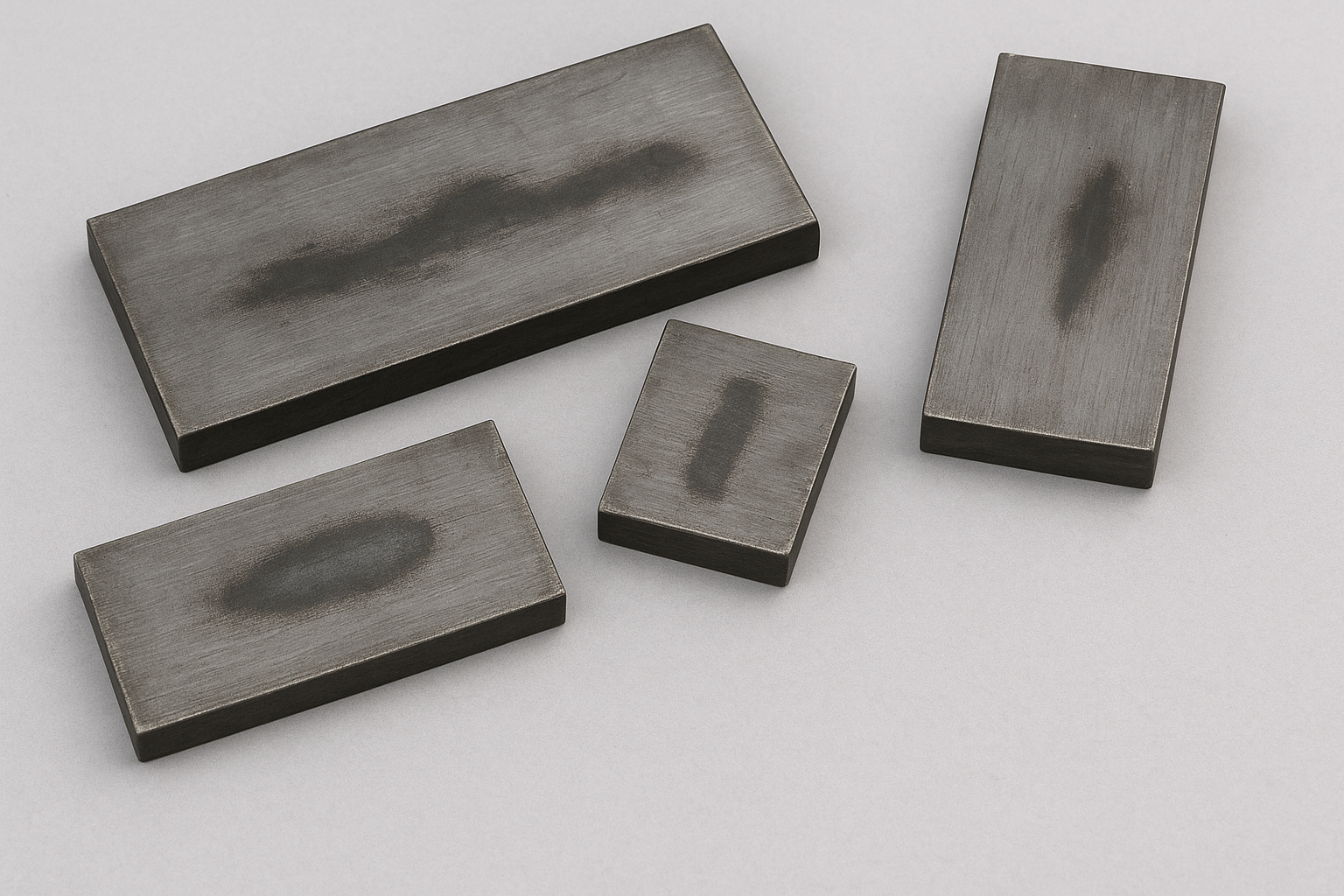
Lamination Plate Samples
Description
Lamination Plate Samples are specialized test pieces used in Non-Destructive Testing (NDT) to qualify procedures, calibrate equipment, and certify personnel for inspecting materials with a layered structure.
These samples fall into two main categories: Metallic Laminated Plates (like rolled steel plates) and Composite Laminates (like Carbon Fiber Reinforced Polymer/CFRP).
Defects Targeted by Lamination Samples
Lamination plate samples are crucial because they contain or simulate flaws that lie parallel to the surface, which are difficult to detect and characterize using standard angle-beam techniques.
1. Metallic Laminations (Rolled Plates)
In metal plates (typically carbon steel), lamination defects are thin, flat, subsurface separations.
-
Origin: These occur during the rolling process. Any pre-existing inclusions, porosity, or internal flaws in the original ingot/slab get elongated and flattened between the rolling passes, creating a distinct, layered discontinuity.
-
Significance: These defects drastically reduce the strength of the plate in the thickness direction (through-thickness strength), making them unacceptable for critical welds or pressure vessel applications.
-
Primary NDT Method: Ultrasonic Testing (UT) using a straight-beam (0°) probe is the standard method for detection and sizing. The lamination acts as a perfect reflector, causing the sound wave to return to the transducer immediately, resulting in a loss of the back-wall echo or a large intermediate reflection.
2. Composite Laminations (Delamination)
In fiber-reinforced composite materials (like CFRP or GFRP), the primary defect is called delamination or disbond.
-
Origin: These occur between adjacent layers (plies) due to manufacturing errors (e.g., poor resin wetting, foreign objects, porosity) or in-service impact damage (Barely Visible Impact Damage – BVID).
-
Significance: Delaminations compromise the structural integrity, reducing stiffness and compressive strength.
-
Primary NDT Method: Phased Array Ultrasonic Testing (PAUT) or conventional pulse-echo UT in the C-Scan mode is preferred.
-
Calibration Sample Features: Composite calibration samples often use thin Teflon inserts placed between plies at various depths (near-side, middle, far-side) and various sizes to simulate the planar delamination flaw for calibration and resolution checks.
-
Standards and Calibration
The design and use of lamination samples are governed by industry codes:
-
ASTM A578/A578M and ASME SA-435/SA-435M: These standards specify the straight-beam UT procedures for examining steel plates for laminar discontinuities and require a loss of back reflection to be recorded as an indication.
-
ASTM E2580: Standard Practice for Ultrasonic Testing of Flat Panel Composites and Sandwich Core Materials. This provides guidelines for using both Pulse-Echo and Through-Transmission techniques for detecting delamination and disbonds.

Reviews
There are no reviews yet.