
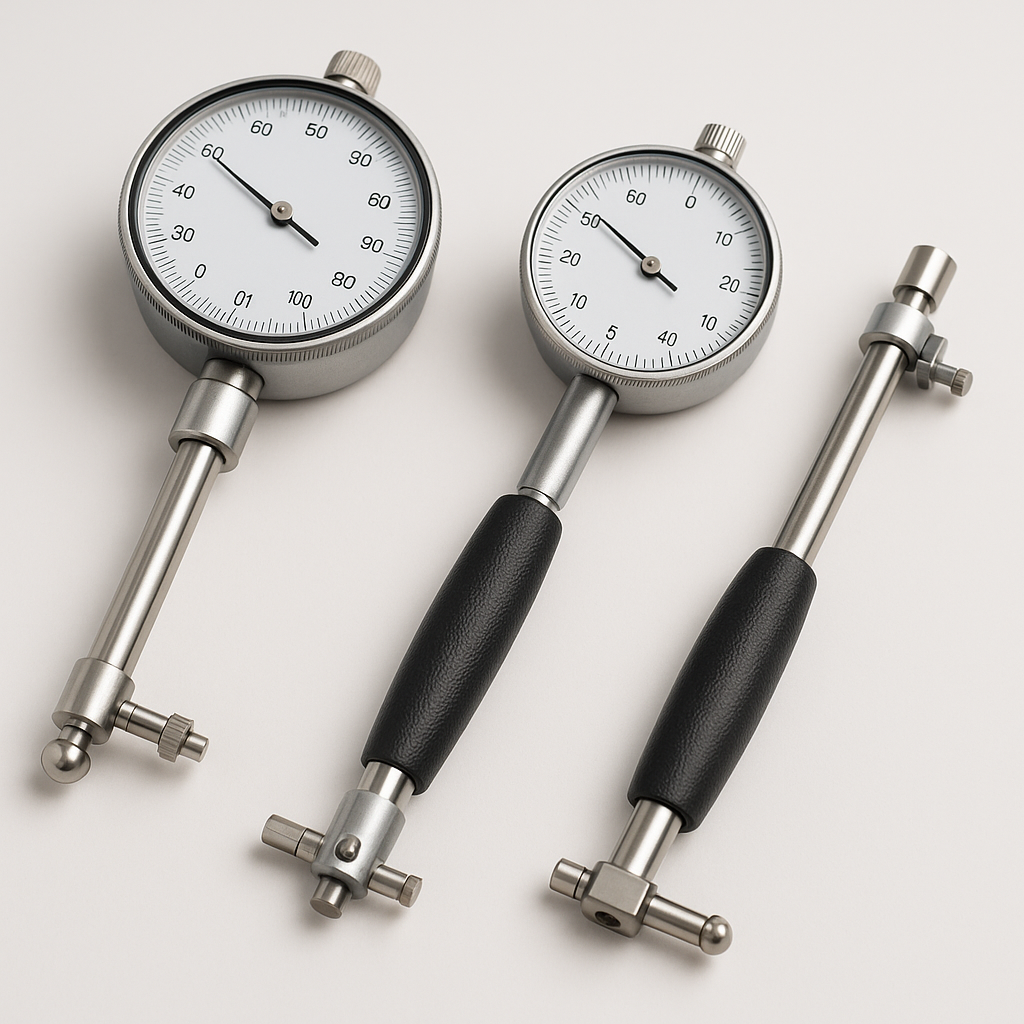
Bore Gauges
Description
Bore Gauges: Measuring Internal Diameters
Bore Gauges are precision measuring instruments used to accurately determine the internal diameter (ID) of holes, cylinders, pipes, or bores. They are essential tools in manufacturing, engine building, and quality control where maintaining precise dimensional tolerances for internal features is critical.
Bore gauges generally consist of a handle, a measuring head, and an indicator (dial or digital) to display the measurement. They are most effective when measuring diameters that are difficult or impossible to reach with standard calipers or micrometers.
1. Types of Bore Gauges
The choice of gauge depends on the required accuracy, the size of the bore, and the application:
A. Dial/Digital Bore Gauges (Comparative)
-
Principle: These are comparative gauges. They do not measure the absolute diameter directly. Instead, they must first be preset or zeroed against an external standard, such as a setting ring (master ring) or an external micrometer set to the nominal bore size.
-
Operation: The measuring head has three contact points (two fixed anvils and one central movable contact) that expand to meet the bore wall. The movement of the central contact is magnified and displayed on the dial or digital indicator. The gauge shows the deviation (the difference) between the nominal setting size and the actual bore size.
-
Reading: The final bore size is calculated as: Nominal Setting Size $\pm$ Deviation Reading.
-
Least Count: Typically $0.01\ \text{mm}$ or $0.001\ \text{mm}$ (or $0.0005\ \text{in}$).
B. Internal Micrometers (Direct Reading)
-
Principle: These gauges measure the dimension directly without needing a setting master.
-
Types:
-
Telescoping Gauges: Use spring-loaded plungers that lock after being inserted and removed from the bore. The final dimension is then measured externally with a standard micrometer.
-
Three-Point Internal Micrometers: Have three self-centering contact points that expand via a thimble/ratchet mechanism. The reading is taken directly from the barrel scale. These are generally faster and more precise than telescoping gauges.
-
2. Key Applications and Importance
-
Cylinder Measurements: Crucial for measuring the straightness, roundness (ovality), and taper of engine cylinders during rebuilds.
-
Bearing Housings: Used to ensure bearing bores meet strict tolerances for press-fit and running clearance.
-
Quality Control: Essential for checking machined parts (e.g., hydraulic components, bushings, gear housings) to confirm they conform to design specifications.
The accuracy and reliability of bore gauges are critical because internal dimensions often define the fit and function of assembled components.

Reviews
There are no reviews yet.