

ULTRASONIC TESTING
Assured
Returns
Enquiry
Support
Ultrasonic Testing (UT)
Ultrasonic Testing (UT) is a widely used non-destructive testing (NDT) technique employed to detect internal flaws or discontinuities in materials without causing damage. It utilizes high-frequency sound waves, typically above 20 kHz, to probe the test specimen. The principle behind UT is similar to echolocation, where sound waves are introduced into the material, and their reflections or transmissions are analyzed to glean information about the material's integrity.
How it Works:
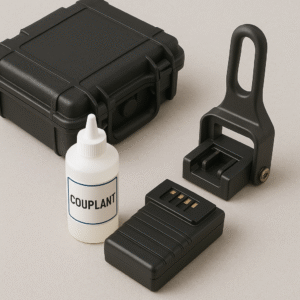
The core of UT involves a transducer, a device that converts electrical energy into mechanical vibrations (sound waves) and vice-versa. This transducer is placed on the surface of the material, often with a couplant (like gel or water) to ensure efficient transmission of sound. The transducer generates ultrasonic pulses that propagate through the material. When these sound waves encounter a discontinuity – such as a crack, void, or inclusion – part of the sound energy is reflected back to the transducer, while the rest continues to travel through or around the flaw.
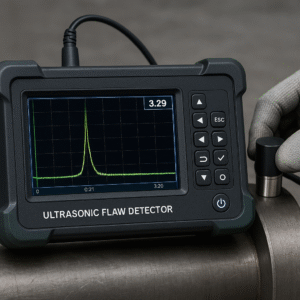
The reflected sound waves, or "echoes," are then converted back into electrical signals by the transducer and displayed on a screen, typically an oscilloscope or a specialized UT device. The time it takes for the sound to travel to a flaw and return, along with the amplitude of the reflected signal, provides crucial information about the size, location, and nature of the discontinuity.
Types of Ultrasonic Testing:
There are several common UT techniques:
-
Pulse-Echo: This is the most prevalent method. The same transducer acts as both transmitter and receiver. It sends out a pulse and listens for echoes from flaws and the back wall of the material.
-
Through-Transmission: In this method, separate transducers are used on opposite sides of the material. A decrease in the received sound intensity indicates a flaw that obstructs the sound path.
-
Phased Array Ultrasonic Testing (PAUT): This advanced technique uses a transducer array with multiple small elements that can be individually pulsed. This allows for steering and focusing the ultrasonic beam electronically, providing more detailed imaging and faster inspections.
-
Time-of-Flight Diffraction (TOFD): This method uses diffracted signals from the tips of flaws to accurately size them.
Advantages of Ultrasonic Testing:
-
High Sensitivity: UT can detect very small internal flaws.
-
Depth Penetration: It can inspect thick sections of materials.
-
Accuracy in Flaw Location and Sizing: UT can precisely determine the position and dimensions of defects.
-
Instantaneous Results: Inspections provide real-time data.
-
Versatility: Applicable to a wide range of materials, including metals, plastics, and ceramics.
-
Non-Destructive: The material being tested remains intact.
Applications:
Ultrasonic testing is indispensable across numerous industries, including:
-
Aerospace: Inspecting aircraft components for fatigue cracks and manufacturing defects.
-
Oil and Gas: Checking pipelines, pressure vessels, and storage tanks for corrosion and flaws.
-
Power Generation: Assessing welds and components in nuclear and thermal power plants.
-
Manufacturing: Quality control of castings, forgings, and welded structures.
-
Automotive: Inspecting critical components like engine blocks and axles.
In conclusion, ultrasonic testing remains a cornerstone of modern quality assurance and safety protocols, playing a vital role in ensuring the reliability and integrity of materials and structures in a multitude of critical applications.
No Reviews Yet
Be the first to share your experience with this product.
Get a Quote for ULTRASONIC TESTING
Our NDT specialists will respond within 24 hours with pricing, specifications, and lead times. For urgent requirements, reach us directly via WhatsApp or phone.