
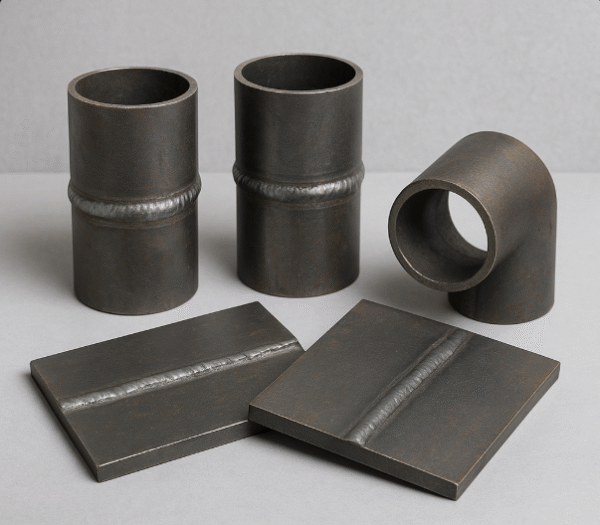
Welded Pipe Samples
Assured
Returns
Enquiry
Support
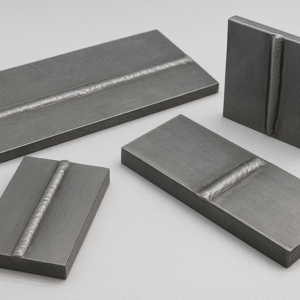
Welded pipe samples are specialized test pieces used in Non-Destructive Testing (NDT) to create a realistic environment for equipment calibration, procedural qualification, and personnel certification for inspecting pipe welds.
The curvature of the pipe creates unique challenges for NDT methods, especially ultrasonic testing (UT) and Phased Array UT (PAUT), which these samples are designed to address.
Primary Applications
Welded pipe samples are divided into two main categories based on their function: Calibration Blocks and Flawed Specimens.
1. Calibration Blocks (Reference Standards)
These are used to set up the NDT equipment accurately before an inspection.
-
Function: They are typically a section of pipe with a butt weld, matching the geometry (diameter and wall thickness) and material of the component to be inspected. They contain precisely machined reference reflectors.
-
Key Requirements: Standards like ASME Section V and API require these blocks to contain reflectors like Side-Drilled Holes (SDH) or EDM Notches (Electrical Discharge Machining) at specific depths and orientations (axial and circumferential) to:
-
Set the sound velocity and zero offset.
-
Establish sensitivity (gain) and Time-Corrected Gain (TCG) or Distance Amplitude Correction (DAC) curves to compensate for signal loss due to curvature and attenuation.
-
Verify the accurate refracted angle of angle beam transducers.
-
2. Flawed Specimens (Demonstration Blocks)
These are used for training, procedure validation, and personnel qualification exams.
-
Function: They are actual welded pipe joints that contain purposely induced, real-world flaws of known types, sizes, and locations. They simulate the discontinuities that would naturally occur during the welding process.
-
Documentation: Each specimen is supplied with detailed documentation (sometimes verified by a third party) that maps the location and dimensions of the internal flaws, allowing the inspector's results to be accurately graded.
Common Flaws Found in Welded Pipe Samples
Flawed pipe specimens are fabricated to contain a mixture of planar and volumetric defects, strategically placed in the weld root, fusion line, or weld body.
| Flaw Type | Description | Location & Significance |
| Lack of Fusion (LOF) | Failure of the weld metal to melt and bond with the side wall or previous pass. | Planar Flaw. Highly critical, often running axially or circumferentially along the bevel (fusion face). |
| Incomplete Penetration (IP) | Weld metal fails to fully fill the root of the groove joint. | Planar Flaw. Located at the pipe's Inner Diameter (ID) root. Difficult to detect and size accurately. |
| Cracks | Linear discontinuities (e.g., toe cracks, root cracks, transverse cracks). | Planar Flaw. Highly rejectionable. Require good resolution and accurate sizing. |
| Slag Inclusions | Non-metallic compounds trapped in the weld. | Volumetric Flaw. Typically appear as rounded or elongated indications on a radiograph (RT) but complex on UT. |
| Porosity | Spherical gas pockets trapped within the weld metal. | Volumetric Flaw. Often clustered. Easier to detect via RT than UT, but must be assessed by both. |
Design Standards for Pipe Blocks
The curvature of the pipe means that calibration must account for the changing path of the sound beam. Key standards governing the design and use of these pipe samples include:
-
ASME Section V, Article 4: Specifies the requirements for ultrasonic calibration blocks, including that the block must be of the same nominal diameter, schedule (wall thickness), and material as the component being inspected. For curved surfaces, a specific range of pipe diameters can be qualified using a single block.
-
API 1104: Standard for welding pipelines and related facilities. This standard often dictates the use of performance demonstration test specimens with flaws for qualifying both procedures and personnel for pipeline girth welds.
-
ASTM E2491: While general, this guide covers the assessment of PAUT systems, which are increasingly used for complex pipe weld inspections and require specific curved calibration blocks.
No Reviews Yet
Be the first to share your experience with this product.
Get a Quote for Welded Pipe Samples
Our NDT specialists will respond within 24 hours with pricing, specifications, and lead times. For urgent requirements, reach us directly via WhatsApp or phone.