
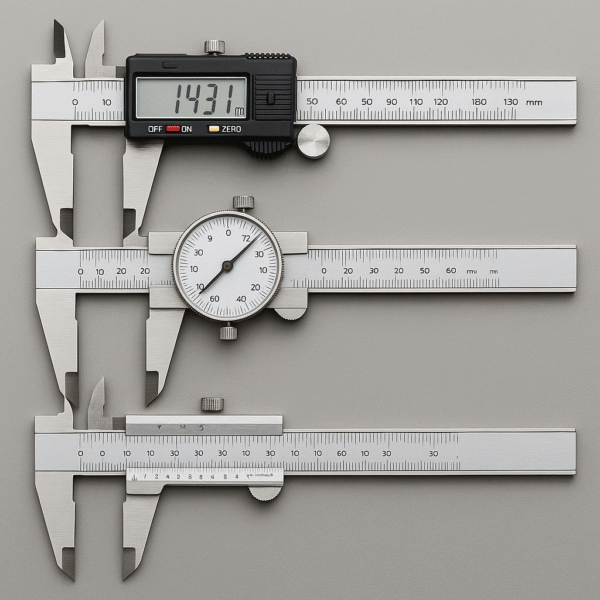
Vernier Calipers (Digital / Dial / Analog)
Assured
Returns
Enquiry
Support
Vernier Calipers: Precision Measurement Tools
Vernier Calipers are precision measuring instruments used to measure linear dimensions—specifically, external diameter, internal diameter, and depth—with high accuracy. They are fundamental tools in engineering, manufacturing, and quality control.
All types of Vernier calipers rely on two main scales: a main scale and a smaller, movable scale (the Vernier or dial scale) that allows for reading measurements that are finer than the smallest graduation on the main scale.
1. Analog Vernier Calipers (Traditional)
The classic form of the tool, requiring manual reading and interpretation of the Vernier scale.
-
Principle: Uses the Vernier principle, where a small, movable scale slides along the main scale. The smallest division on the Vernier scale is slightly smaller than the smallest division on the main scale. The reading is taken where a line on the Vernier scale exactly aligns with a line on the main scale.
-
Reading: Requires visual acuity and careful interpretation of the alignment.
-
Least Count: Typically $0.02\ \text{mm}$ or $0.001\ \text{in}$.
-
Advantage: Does not require batteries; highly durable.
-
Disadvantage: Prone to reading errors and slower to use.
2. Dial Calipers
Dial calipers simplify the final reading by converting the Vernier scale into a mechanical gauge (dial).
-
Principle: The movement of the slide drives a gear mechanism connected to a pointer on a circular dial. The main scale provides the larger units (like millimeters), while the dial shows the finer fractional units.
-
Reading: The measurement is read directly from the main scale and the needle position on the dial.
-
Least Count: Typically $0.01\ \text{mm}$ or $0.001\ \text{in}$.
-
Advantage: Easy to read, reduces reading errors, and offers a zero-setting capability on the dial.
-
Disadvantage: More susceptible to mechanical damage and gear backlash than analog models.
3. Digital Calipers
Digital calipers provide the fastest and most convenient reading by using an electronic sensor (capacitive encoder) to measure movement and display the result numerically.
-
Principle: A sliding capacitive sensor measures the change in electrical capacitance as the slide moves, translating the displacement into a precise digital reading.
-
Reading: The measurement is displayed immediately on an LCD screen.
-
Least Count: Typically $0.01\ \text{mm}$ or $0.0005\ \text{in}$.
-
Key Features: Instant metric/imperial conversion, zero-setting (relative measurement), and often data output capabilities.
-
Advantage: Fastest reading, highest precision, and minimizes human error.
-
Disadvantage: Requires a battery, susceptible to damage from coolant and electronic interference.
No Reviews Yet
Be the first to share your experience with this product.
Get a Quote for Vernier Calipers (Digital / Dial / Analog)
Our NDT specialists will respond within 24 hours with pricing, specifications, and lead times. For urgent requirements, reach us directly via WhatsApp or phone.